Categories
Imagine construction sites piled high with metal paint buckets, each with dried paint film residue inside. Most of these buckets are discarded after just one use or require large amounts of solvent and water resources for cleaning.According to industry data, in China alone, tens of millions of paint packaging barrels become hazardous waste requiring special treatment each year.
Why do cylindrical barrels consume massive resources?
The renovation and industrial sectors have long faced a dilemma: repeatedly using barrels incurs staggering cleaning costs, while directly discarding them leads to significant resource waste and environmental pollution.After holding paint, coatings, or chemical liquids, traditional metal or plastic cylindrical barrels retain a large amount of residue on their inner walls. This residue is not only difficult to remove, requiring substantial amounts of organic solvents and water, but the wastewater generated from cleaning itself becomes a new pollutant.
When the barrels eventually become unusable, packaging barrels with chemical residues are classified as hazardous waste. The cost of disposing of such waste is high, reaching thousands of yuan per ton, and the disposal process may still cause secondary environmental impacts.
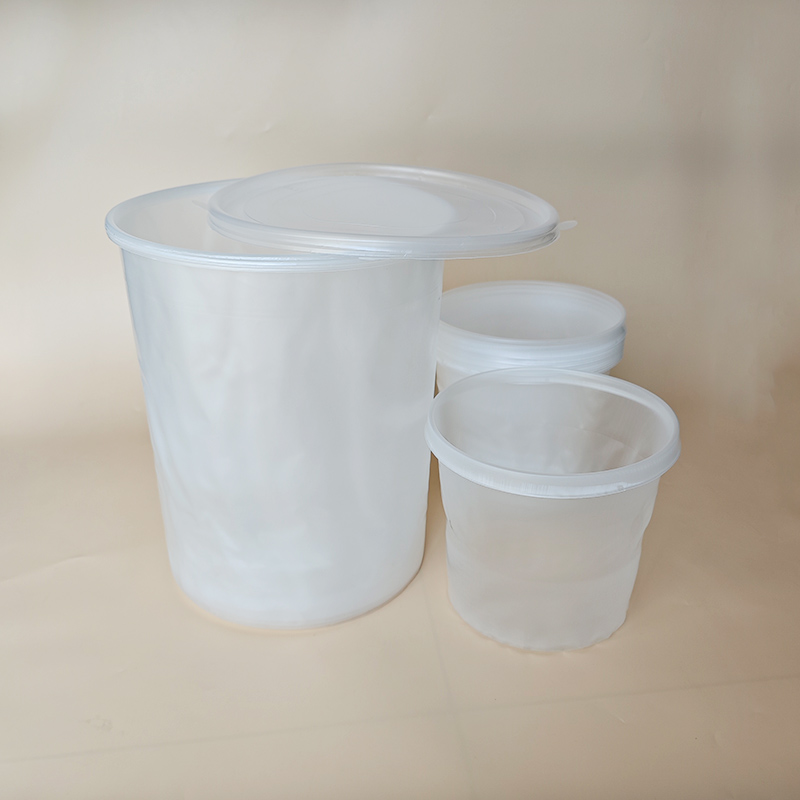
What is a disposable Round Bottom Barrel liners?
A disposable cylindrical barrel liner is essentially a flexible isolation layer added inside a traditional sturdy barrel. This thin layer of PE or PP plastic film plays a key role in the resource cycle.From a materials science perspective, these liners are mostly made of polyethylene or polypropylene, which offer good chemical stability and can withstand the erosion of most paints and chemical liquids.
At the same time, their thickness is carefully designed to ensure sufficient strength while minimizing plastic usage.When the liquid material is used up, simply remove the liner along with the small amount of residue, and the barrel beneath remains clean as new, ready for immediate reuse. This simple action changes the entire resource utilization equation.
How much resources can disposable Round Bottom Barrel liners save?
The environmental value of disposable round bottom bag can be analyzed quantitatively across several dimensions. First, in terms of resource conservation, data show that using liners can extend the lifespan of the barrels themselves by 5–8 times.The savings in the cleaning process are even more astounding. Traditionally, cleaning an 18-liter paint bucket requires an average of 3–5 liters of water and an appropriate amount of solvent. With liners, this demand drops to nearly zero.
From the perspective of hazardous waste reduction, using liners can reduce the hazardous waste generated by each barrel by approximately 90% over its lifecycle. These data together paint a clear picture of environmental benefits.
The table below compares the main differences between traditional methods and using liners:
|
Comparison Dimension |
Traditional Method |
Using Disposable Liners |
|
Average Lifespan of Barrel |
1–3 uses |
15–25 uses |
|
Water Consumption per Cleaning |
3–5 liters/barrel |
Nearly 0 liters |
|
Hazardous Waste Generated |
Residue after each use + final barrel disposal |
Only liner and small amount of residue |
|
Comprehensive Usage Cost |
High (cleaning + disposal costs) |
Low (only liner cost) |
Why do we need disposable Round Bottom Barrel liners?
In the renovation industry, Chnpack disposable liners are gradually becoming standard practice. From small home renovation projects to large construction projects, teams find that using liners is not only environmentally friendly but also significantly improves work efficiency.Workers no longer need to spend a lot of time cleaning barrels. Instead, they can quickly replace the liners and move on to the next task. This efficiency improvement can save 15%–20% of labor hours in actual projects.The applications in the industrial sector are even broader. Industries such as chemicals, pharmaceuticals, and food processing use liners of different materials and specifications to meet their specific hygiene and safety requirements. In some high-standard workshops, the use of liners is even a mandatory hygiene measure.

Tongcheng Tianbai Plastic Co., Ltd.






Copyright © 2012-2026 Tongcheng Tianbai Plastic Co., Ltd.. All Rights Reserved.
 IPv6 network supported
Scan to wechat:

 +86 18919699986
 inquiry@chnpack.com